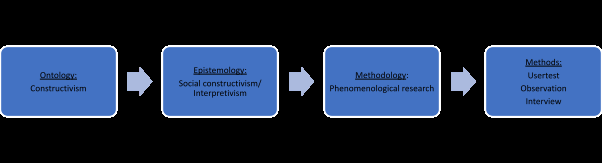
| Research design:
For the phenomenological perspective to our research an exploratory research approach is chosen in order to investigate the phenomenon of the perception of and the reaction to Digital humans in order to understand this area of interest more thoroughly. Exploratory research is in its nature research conducted to unravel a research area that might not be clearly defined and has been under-investigated and is commonly described as interpretive research (Singh, 2007). The purpose not being to derive conclusive results, but rather to gain insights that can form ideas, reflections, hypotheses, and more specific research moving on.
Exploratory research is generally considered to be inductive and qualitative (Stebbins 2001), and may include observations, interviews, and surveys to state a few examples. However, in this case a two-sided approach was chosen, involving both quantitative and qualitative methods like i.e. user tests, observations, and interviews. The reasoning behind this was to be able to work deductively on the basis of the theoretical framework gathered through the literature review and with the data from the user test and through this focus on “mean” behavior and therein seek assumptions, which then would be tested in the inductive way through the i.e. observations, recordings, and interviews in order to understand dynamics and behavior.
This approach seemed the best fit, since the purpose was to uncover both PERCEPTION and REACTION and as such there was a need for quantitative data on the participants choices and physiological response to the tests, as well as the psychological (sociological) side of it, which was covered through interviews, heatmaps, observations and recordings. As such the quantitative approach was selected for the part of the user test, which involved likert-scale questions and biometrical measurements as facial expression analysis. For the qualitative part of the study heatmaps, recordings, observations and interviews were used. To elaborate – the focus was to use the User test (part 1) to get the participants to interact and experience a digital human online, whilst recording and tracking this interaction through Imotions software, make observations on top of this and then move to the user test (part 2), where the participants initiated a online test where they first off were presented with likert-scale questions in relation to user test (part 1) and thereafter were introduced to avatar – 3 illustrations (pictures) of digital humans and were asked to choose between these skins for both male, female and profession choices. On top of this the interviews were conducted.
Methods of research:
Usertest
The user test (NNgroup.com, 2022) is a moderated, in-person test with an explorative focus and the tests were conducted at SDU as 12 individual tests in August 2023. Before initiating the real tests, a pilot test was performed to find potential issues with the testing setup. After this a few edits were made, and the tests were initiated. The online test of the digital humans was made using rented equipment with Imotions software, which allowed the construction of an online test in 2 parts, which had both the eye tracking, facial expression analysis and video recording of the participants as functions. Initially the participants (see description of sampling below) were briefed orally on the test setup; the purpose of the test, the test scenario and the functionality involved (through a testing manuscript (see figure 4 below) which the test moderator read aloud) and were asked to sign a consent form.
Now the participants were ready for the test and were put in front of a laptop computer on a table. Before the test was initiated, they had to look and follow a dot on the screen with their eyes for a little while, so that the software could calibrate the gaze and eye tracking and facial expression was activated. Using a desktop is for this test purpose a bit of a constructed reality, as we cannot test on all possible devices e.g., kiosk – like a stand at a reception), a big screen at a tourist office etc., which might also be used for a digital human encounter. Chrome is chosen as the default browser for the test, as this is the predominantly most used browser in the world with 63,56% and therefore the likelihood that the NTT DATA application is browser optimized towards this is very high (www.oberlo.com, 2023).
Part 1 – Online user test with digital human:
The participants started with part 1 of the test and were presented with 2 explanatory pages
on the screen, before they got access to the NTT Data Digital Human interface via a link,
which opened within the Imotions test application. The NTT Data Digital Human interface offered a test scenario, where the participants could meet a digital human tourist guide from Visit Vejle. The test interface took a couple of minutes to load and from there the test would begin. If the person was inactive for 5 min.
the program would shut down – the participants were informed about this possibility, but none experienced it. There was a possibility of changing between Danish and English language whilst testing, but the main purpose was to test in Danish, which was the default language. The digital humans and the answers they were programmed with, were pre-defined and only had to do with Visit Vejle topics. This means that the context theparticipants were presented with throughout these tests was “staged” and not as such a natural encounter, as they might get if they were to visit Krifa, who has a digital receptionist that you can meet “in person” (https://nttdata-solutions.com/dk/success-stories/krifa-it-human/ ). However, as the purpose is still to explore the perception of and reactions to a digital human through a digital human encounter and not evaluate on functionality of the NTT Data’s Digital Human interface, it is considered to be a valid test foundation.The participants performed the test through talking to/interacting with the digital human and/or clicking on questions on the screen to initiate dialogue with the digital human.
The participants were informed that they had 5 minutes to interact with the digital human and just to “play around”. It was as such an unguided test, as the participants didn’t have a fixed set of tasks to accomplish or things to ask about. After 5 min. the moderator would ask if they felt that they had tried what they wanted to try out and if the answer was yes, then the test application was shut down.
Part 2 – Online test with dimensional questions and avatar illustrations:
As soon as the window with the digital human test application was shut down, the 2nd part of the online stage was initiated. First of the participants were met by an explanatory page, which described how they would be met with 8-dimensional survey questions based on the 5 min. test with the digital human, which they had just finished. These were the 8-dimensional survey questions. After this the participants had to select between male avatars, female avatars and either or for specific professions.
During the testing (both part 1 and part 2) the eyetracking, facial expression analysis and video recording was active as well as the observations were being made.
Eyetracking (heatmaps), facial expression analysis and video recording
Through the Imotions software the online test was set up with eye tracking, which meant that the participants’ gaze was tracked and recorded. The output comprises gaze points, which can be visualized in a heatmap. The heatmap shows how fixations and gaze points are distributed by using green, yellow and red areas, to show the density of gaze points in specific parts of the area of interest. The more density in a certain area, the redder the zone will be. In so many words – the redder, the more interest that area has to the participants (https://imotions.com/blog/learning/best-practice/eye-tracking/). Moreover the Imotions software offers a biometrical tool such as facial expression analysis which measures the facial response/expression and through a facial recognition pattern labels this as an emotion https://imotions.com/blog/learning/best-practice/facial-expression-analysis/). The 6 emotion values which were utilized are : Joy, Sadness, Fear, Anger, Disgust, Surprise.
Applying this to the research meant that the participants’ emotional responses to meeting a digital human and the avatar visuals during the online test, were captured unbiased by self-awareness and social desirability. On top of this the Imotions software allowed for video recordings of participants’ faces,
whilst taking the online test of the digital human (Part 1), which supports the emotions gathered from the facial expression analysis. Both eye tracking (heatmaps) as well as the facial expression analysis and the videos show elements of the participants reactions at a physiological level.
Observations:
There were 2 test facilitators present during the test. One facilitator acted as a test moderator and initially briefed and guided and was the one the participants could communicate with and ask questions, if needed. The moderator would also take observational notes during the test, if the need arose. The other test facilitator was though the primary observator and made observational notes, also known as Memoing (Miles & Huberman, 1984) during the test thereby soliciting the feedback and documenting the physical and psychological reaction. These could be reactions like frowns, laughs, snorts, their approach to dialogue – offensive or defensive and their politeness. The tests were also video recorded to document the physical reaction to the test, the questions, and the experience (Ingemann m.fl. 2022). Having 2 test facilitators present helped facilitate the tests and the observing and documenting the experiment and the reactions. However, 2 test facilitators present might also have had an impact on the experience of the participants, as
this may feel a bit overwhelming to them and shape/influence their experience. With a social constructivist research mindset, we therefore accept that we contribute to the construction of responses rather than only get feedback from the participants. This will be taken into account during the research.
B) Interviews:
After the online test (part 1 and 2) the participants were subject to a semi-structured in-depth interview. The purpose of the interview was to dive a bit deeper and examine the participants’ experience in meeting a digital human (test part 1) and exploring the perception of digital humans (test part 1 & part 2) and investigate to find patterns on sentiments. The interviews were based on an interview guide, built in order to have a structure for the interview and make sure that the theoretical framework was applied. The questions were mostly open-ended questions like for example: “Vil du beskrive din oplevelse af det digitale menneske (hende) for mig?”, “Hvad følte du, da du interagerede med det digitale menneske?”. Questions pertaining to the participant’s experiences, feelings, beliefs and convictions about the test subject (Welman & Kruger, 1999). In combination with the questions asked, the participants were shown visual examples of the avatars (male/female), which they were introduced to during test part 2. The reason for this was to be able to go back to their choices and be able to ask clarifying questions in that regard “Du valgte denne mandlige avatar som din foretrukne – hvordan kan det være?”. Also, in order to be enlightened on perceptions regarding digital human looks and characteristics. The interviews were informal interviews and reciprocal, where both researcher and subject were engaged in dialogue, without the researcher replying with guiding/leading answers.TEAMS was used to tape and transcribe the interview, so that there is both a written testament, but also a taped audio version to rely on, if the transcription is incomplete or hard to decode. Researcher number 2 was listening in on the interview and taking notes (Memoing) (Miles & Huberman, 1984), when something interesting came along, to support the transcribed version of the interview. A pilot interview was done to secure, that the interview guide suits the purpose and to catch any inappropriate measures. After this process the final interview-guide was used for the interviews.
Analysis:
After the data from the tests, observations and interviews was collected, the process of processing the data began. First off, the 2 segments previously created – generation/gender were used as a framework for sorting the date. This way we could look at age as a dimension and isolate findings on Gen. Y and Gen. Z and next we could isolate gender and look at the findings from the males versus the females. These segments were applied when we processed the quantitative data to see what the data revealed and how it could be presented. This meant that we could use the dimensional survey questions coupled with the segment data to explore feelings and sentiments in relation to the digital human test (part 1). Moreover, we could look at the choices of male avatars/female avatars/avatars for certain professions coupled with the segment data to
figure out if there were any specific patterns and these indications could then be supplemented through the heatmaps, which could indicate certain inclinations in relation to the choices.
On top of this came the quantitative facial expression analysis data on emotions, the qualitative data sources like the recordings as well as the findings from the interviews. For the interviews – this data was structured and coded using the theoretical framework which we had created from the lit. study so that we are able to form explanations and comprehensive themes in the data (Creswell, 2012a). This is done by sorting the information transcript into manageable segments. From this the thematic network analysis (Creswell 2012a) would begin and the format illustrated below was chosen for the coding The first part of our data processing began as an inductive approach where we let the data speak to us and try to find patterns across our data points. Next up came the process of sorting the qualitative data according to the theoretical framework. This is a deductive approach.
Time frame:
The test plus interview was planned to last approx. 1 hour. Online test approx. 20 mins. and approx. 30 mins. per follow-up interview. All 12 interviews were conducted in august 2023 and the coding and analysis has been an ongoing process since then until January 2024. The dissemination is planned to start Q1 2024 (se plan below).
Literature review:
The purpose of this research was, from the onset, to gather data regarding the perceptions of the research participants about the phenomenon of AI-engineered digital humans and their experience involved – making it a phenomenological study. Phenomenology as research methodology is signified as “the phenomenologists are concerned with understanding social and psychological phenomena from the perspectives of people involved” (Welman and Kruger 1999) – meaning that the research focus is on the lived experience of people. The intent being to “..understand the phenomena in their own terms — to provide a description of human experience as it is experienced by the person herself” (Bentz & Shapiro, 1998). As researchers the focus is to unravel the actual lived and socially constructed experience of a digital human which is why this research is grounded in a social constructivist point of view – creating an interpretive framework (Creswell, 2013) which seeks to understand the experienced world of digital humans and develop meaning that corresponds to the experience. The social constructivist point of view combined with a phenomenological epistemology is founded in the studies interpretive approach where it is sought to create an understanding of the research participants, the views and feelings and their reality through meeting the digital human in a digital interaction and henceforth in visual depictions. In the end, the researched phenomenon we seek to investigate is the perception of and reaction to AI-engineered digital humans. See research framework below:
Theoretical framework for the project – see list of references below.
Primary:
Bond BJ and Calvert SL (2014) A model and measure of US parents’ perceptions of young children’s parasocial relationships. Journal of Children and Media 8(3): 286–304
Chory-Assad, R. M., & Yanen, A. (2005). Hopelessness and loneliness as predictors of older adults’ involvement with favorite television performers. Journal of Broadcasting & Electronic Media, 49, 182–201.
Cox, A. D., Cox, D., and Anderson, R. D. 2005. “Reassessing the Pleasures of Store Shopping,” Journal of Business Research (58:3), pp. 250-259
Cummins, R. G., & Cui, B. (2014). Reconceptualizing address in television programming: The effect of address and affective empathy on viewer experience of parasocial interaction. Journal of Communication, 64, 723-742.doi:10.1111/jcom.12076
Dibble JL, Hartmann T and Rosaen SF (2016) Parasocial interaction and parasocial relationship:conceptual clarification and a critical assessment of measures. Human Communication Research 42(1): 21–44
Donkelaar L. (2018), “How human should a chatbot be?”, University of Twente Faculty of Behavioural, Management and Social Sciences (BMS)
Ellsworth, P., & Ross, L. (1975). Intimacy in response to direct gaze. Journal of Experimental Social Psychology, 11, 592–613
Eyssel, F., Kuchenbrandt, D., Bobinger, S., de Ruiter, L., and Hegel, F. 2012. “’If You Sound like Me, You Must Be More Human: On the Interplay of Robot and User Features on Human-Robot Acceptance and Anthropomorphism,” in Proceedings of the 7th ACM/IEEE International Conference on Human-Robot Interaction, Boston, MA, pp. 125-126.
Fiske, S. T., Cuddy, A. J., Glick, P., and Xu, J. 2002. “A Model of (Often Mixed) Stereotype Content: Competence and Warmth Respectively Follow from Perceived Status and Competition,” Journal of Personality and Social Psychology (82:6), p. 878-902.
Fiske, S. T., Cuddy, A. J., and Glick, P. 2007. “Universal Dimensions of Social Cognition: Warmth and Competence,” Trends in Cognitive Science (11:2), pp. 77-83.
Gefen D. and Straub, D.W. (2004). Consumer Trust in B2C e-Commerce and the Importance of Social Presence: Experiments in e-Products and e-Services. Omega: The International Journal of Management Science, 32(6), 407-424
Gill A., S. Nowson, and J. Oberlander. 2009. What are they blogging about? Personality, topic and motivation in blogs. In ICWSM’09. 18–25.
Grabner-Kraeuter, 2002, “The Role of Consumers’Trust in Online-Shopping”, Journal of Business Ethics 39: 43-50
Goldberg L., 1990, An Alternative “Description of Personality”: The Big-Five Factor Structure, Journal of Personality and Social Psychologs 1990, VoL 59, No. 6, 1216-1229
Hartmann, T., & Goldhoorn, C. (2011). Horton and Wohl revisited: Exploring viewers’ experience of parasocial interaction. Journal of Communication, 61, 1104-1121. (doi:10.1111/j.1460-2466.2011.01595.)
Hassanein, K., Head, M., and Chunhua, J. (2009). A Cross-Cultural Comparison of the Impact of Social Presence on Website Trust, Usefulness and Enjoyment. International Journal of Electronic Business, 7(6), 625-641
Holzwarth, M., Janiszewski, C., and Neumann, M. M. 2006. “The Influence of Avatars on Online Consumer Shopping Behavior,” Journal of Marketing (70:4), pp. 19-36
Horton D and Wohl R (1956) Mass communication and para-social interaction: observations on intimacy at a distance. Psychiatry 19(3): 215–229
Horton, D., & Strauss, A. (1957). Interaction in audience participation shows. The American Journal of Sociology, 62, 579–587
Jin S-AA (2010) Parasocial interaction with an avatar in second life: a typology of the self and an empirical test of the mediating role of social presence. Presence: Teleoperators and Virtual Environments 19(4): 331–340
- Kern, J. Eichstaedt, A. Schwartz, L. Dziurzynski, L. Ungar, D. Stillwell, M. Kosinski, S. Ramones, and M. Seligman. 2013. The online social self: An open vocabulary approach to personality. J. Assess. 21, 2 (2013), 158–169.
Kim, H., Suh, K. S., and Lee, U. K. 2013. “Effects of Collaborative Online Shopping on Shopping Experience Through Social and Relational Perspectives,” Information and Management (50:4), pp. 169-180
Kroencke, L., Harari, G. M., Back, M. D., & Wagner, J. (2022). Well-being in social interactions: Examining personality-situation dynamics in face-to-face and computer-mediated communication. Journal of Personality and Social Psychology.
Koda T and Maes P, 1996. Agents with faces: The effects of personification of agents. In Proc. HCI’ 96. 98–103
Lee, K. M., Jung, Y., Kim, J., and Kim, S. R. (2006). Are physically embodied social agents better than disembodied social agents?: The effects of physical embodiment, tactile interaction, and people’s loneliness in human–robot interaction. International Journal of Human-Computer Studies, 64(10), 962-973
- Lepri, R. Subramanian, K. Kalimeri, J. Staiano, F. Pianes, and N. Sebe. 2012. Connecting meeting behavior with extraversion: A systematic study. IEEE Trans. Affective Comput. 3, 4 (2012), 443–455. conversations. In Proceedings of InterSpeech. 1549–1552.
- Liu, D. Preotiuc-Pietro, Z. Riahi Samani, M. Moghaddam, and L. Ungar. 2016. Analyzing personality through social media profile picture choice. In ICWSM’16.
Lu, Baozhou and Fan, Weiguo, “SOCIAL PRESENCE, TRUST, AND SOCIAL COMMERCE PURCHASE INTENTION: AN EMPIRICAL RESEARCH” (2014). PACIS 2014 Proceedings. 105
Malle, B. F. (2005). Three puzzles of mindreading. In B. F. Malle & S. D. Hodges (Eds.), Other minds: How humans bridge the divide between self and other (pp. 26–43). New York, NY: Guilford Press
Miao F., Kozlenkova I., Wang H., Xie T., and Palmatier R. (2022), “An Emerging Theory of Avatar Marketing”, Journal of Marketing, 2022, Vol. 86(1) 67–90
Mull et all 2015: Mull, I., Wyss, J., Moon, E., and Lee, S. E. 2015. “An Exploratory Study of Using 3D Avatars as Online Salespeople: The Effect of Avatar Type on Credibility, Homophily, Attractiveness and Intention to Interact,” Journal of Fashion Marketing and Management (19:2), pp. 154-168.
Nass C. and Yen C. 2012, The Man Who Lied to His Laptop. Current
Nowak K., Fox J., and Ranjit Y.. 2015. Inferences about avatars: Sexism, appropriateness, anthropomorphism, and the objectification of female virtual representations. J. Comput. Mediated Commun. 20, 5 (2015), 554–569
O’Guinn, T., Tanner, R. J., and Maeng, A. 2015. “Turning to Space: Social Density, Social Class and the Value of Things in Stores,” Journal of Consumer Research (42:2), pp. 196-213
Pavlou, P.A., Liang, H., and Xue, Y. (2007). Understanding and mitigating uncertainty in online exchange relationships: A principal-agent perspective. MIS Quarterly, 3(11), 105-136
Powers A., Kiesler S., and Goetz J., 2003. Matching robot appearance and behavior to tasks to improve human-robot cooperation. In Proceedings of the 12th IEEE International Workshop on Robot and Human Interactive Communication, vol. IXX, 55–60
Qiu, L. and Benbasat, I. (2005). An investigation into the effects of text-to-speech voice and 3D avatars on the perception of presence and flow of live help in electronic commerce. ACM Transactions on Computer-Human Interaction, 12(4), 329-355
Schramm H and Hartmann T (2008) The PSI-Process Scales. A new measure to assess the intensity and breadth of parasocial processes. Communications 33(4): 385–401.
Sharma M., Vemuri K., (2022), “Accepting Human-like Avatars in Social and Professional Roles”, ACM Transactions on Human-Robot Interaction,Volume 11, Issue 3, September 2022
Seymour M, Yuan L, Dennis A, Riemer K (2021) Have We Crossed the Uncanny Valley? Understanding Affinity, Trustworthiness, and Preference for Realistic Digital Humans in Immersive Environments, January 2021, Journal of the Association for Information Systems 22(3): 591-617
Sheldon Z, Romanowski M and Shafer DM (2021) Parasocial interactions and digital characters:the changing landscape of cinema and viewer/character relationships. Atlantic Journal ofCommunication 29(1): 15–25
Short J, Williams E, and Christie B. (1976). The social psychology of telecommunications. Wiley, London
Silva E.S. , Bonetti F. (2021), Digital humans in fashion: Will consumers interact?, Journal of Retailing and Consumer Services Volume 60, May 2021
Sproull L, Subramani M, Kiesler S., Walker J., and Waters K. 1996. When the interface is a face. J. Hum. Comput.Interact. 11, 2 (1996), 97–124
Stein, Breves, Anders, 2022, “Parasocial interactions with real and virtual influencers: The role of perceived similarity and human-likeness”, New media & society p. 1–21
Tapus A., Tapus C., and Mataric M., 2008. User-robot personality matching and assistive robot behavior adaptation for post-stroke rehabilitation therapy. Intell. Serv. Rob. 1, 2 (2008), 169–196.
Turban, E., Outland, J., King, D., Lee, J. K., Liang, T. P., Turban, D. C., & Turban, D. C. (2018). Intelligent (smart) E-commerce. In Electronic commerce 2018: A managerial and social networks perspective (pp. 249–283). Springer Charm
Wölfl and Feste, 2018, Do You Trust Me? Facial Width Width-to -Height Ratio of Website Avatars and Intention to Purchase from Online Store, Thirty Ninth International Conference on Information Systems, San Francisco 2018
Yarkoni T., 2010. Personality in 100,000 words: A large-scale analysis of personality and word usage among bloggers. J. Res. Personality 44, 3 (2010), 363–373
Yee N., Bailenson J., and Rickertsen K. 2007. A meta-analysis of the impact of the inclusion and realism of humanlike faces on user experiences in interfaces. In Proceedings of the SIGCHI Conference on Human Factors in Computing Systems. ACM, 1–10
Yin J, Wang S, Guo W, et al. (2021) More than appearance: the uncanny valley effect changes with a robot’s mental capacity. Current Psychology. Epub ahead of print 10 September
Youn S and Jin SV (2021) “In A.I. we trust?” The effects of parasocial interaction and technopian versus luddite ideological views on chatbot-based customer relationship management in the emerging “feeling economy.” Computers in Human Behavior 119: 106721
Zhang, X., Li, S., Burke, R., and Leykin, A. 2014. “An Examination of Social Influence on Shopper Behavior Using Video Tracking Data,” Journal of Marketing (78:5), pp. 24-41
Michelle X. Zhou, Gloria Mark, Jingyi Li, and Huahai Yang. 2019. Trusting Virtual Agents: The Effect of Personality. ACM Trans. Interact. Intell. Syst. 9, 2–3, Article 10 (March 2019), 36 pages
https://tech.fb.com/ar-vr/2019/04/avatars-the-art-and-science-of-social-presence/ (accessed 25. Nov. 2022)
Methodology:
Bentz, V. M., & Shapiro, J. J. (1998). Mindful enquiry in social research. Thousand Oaks, Sage.
Creswell, J. W. (1998). Qualitative inquiry and research design: Choosing among five traditions. Thousand Oaks, Sage.
Creswell, J. W. (2012a). Educational Research: Planning, Conducting, and Evaluating Quantitative and Qualitative Research (4th Edition, International edition ed.): PEARSON Publications
Creswell, J.W. (2013). Qualitative inquiry & research design: choosing among the five approaches. Thousand Oaks, Sage Publications, Inc.
Ingemann m.fl. 2022, Kvalitative undersøgelser i praksis, Samfundslitteratur
Gray, D. E. (2014). Doing research in the real world, Sage.
Kvale, S. (1996). Interviews: An introduction to qualitative research interviewing. Thousand Oaks, Sage
Miles, M. B., & Huberman, A. M. (1984). Qualitative data analysis, a sourcebook of new methods. Newbury Park, Sage.
O’Gorman, K. and MacIntosh, R. (2015). “Mapping research methods”. in: O’Gorman, K. and MacIntos, R. Research methods for business and management. Goodfellow Publishers Ltd.
Polit, D. F. & Beck, T.C. (2010). Generalization in Quantitative and Qualitative Research: Myths and Strategies. International Journal of Nursing Studies 47(11), 1451–58.
Stebbins, R.A.: Exploratory Research in the Social Sciences. Sage, Thousand Oaks (2001)
Welman, J. C., & Kruger, S. J. (1999). Research methodology for the business and administrative sciences. Johannesburg, International Thompson.
WEB:
https://www.nngroup.com/articles/guide-ux-research-methods/ (accessed 18. Nov. 2022)
https://www.beresfordresearch.com/age-range-by-generation/ (accessed 18. Nov. 2022)
https://nttdata-solutions.com/dk/success-stories/krifa-it-human/ (accessed 22. Nov. 2022)
https://tech.fb.com/ar-vr/2019/04/avatars-the-art-and-science-of-social-presence/ (accessed 25. Nov. 2022)
https://nttdata-solutions.com/dk/products/customer-experience-crm/it-human-platform/ (accessed 25. Nov. 2022)
https://www.visitvejle.dk/vejle/oplevelser/cykelferie/visitvejles-avatar (accessed dec. 2023)
(https://bornholm.nu/nyheder/bridget-bliver-tv-vaert-paa-bornholmnu/105647) (accessed dec. 2023)
Y-Pulse AI Unpacked Trend Report, May 2023 from: https://www.linkedin.com/pulse/how-do-gen-z-millennials-really-feel-ai-ypulse/ (accessed dec. 2023)
https://psychcentral.com/health/why-do-we-anthropomorphize#anthropomorphism (accessed dec. 2023)
Secondary:
https://nttdata-solutions.com/dk/products/customer-experience-crm/it-human-platform/
The Science of AI: Why Chatbots Will Never Replace Human Workers (2020) available from < https://www.linkedin.com/pulse/science-ai-why-chatbots-never-replace-human-workers-haleemah-alaydi > [14 March 2022]
CGS Survey Reveals Consumers Prefer a Hybrid AI/Human Approach to Customer Service. Is There Chatbot Fatigue? (2019) available from < https://www.cgsinc.com/en/resources/2019-cgs-customer-service-chatbots-channels-survey > [14 March 2022]
Chatbots.org 3000 participant survey (2018) available from < https://www.chatbots.org/images/news/chatbot_survey_2018.pdf > [14 March 2022]
GPT-3 Powers the Next Generation of Apps (2021) available from < https://openai.com/blog/gpt-3-apps/ > [14 March 2022]
Kulager, F. (2022) “Det er otte år siden, du døde.” Mød manden, der genoplivede sin forlovede som chatbot [online] available from < https://www.zetland.dk/historie/s8RVa6nD-aOZj(67pz-f503c > [14 March 2022]
The GPT-3 Leta Video Series – Dr Alan D. Thompson – Life Architect (2022) available from < https://lifearchitect.ai/leta/ > [14 March 2022]
Two AIs talk about becoming human (GPT-3) – Jack Soslow’s YouTube channel (2021) available from < https://www.youtube.com/watch?v=jz78fSnBG0s&t=9s > [14 March 2022]
Wölfl, S. and Feste, J. (2018) Do You Trust Me?: Facial Width-to-Height Ratio of Website Avatars and Intention to Purchase from Online Store. [online] available from < https://fis.uni-bamberg.de/handle/uniba/44672 > [14 March 2022]
Lu, B., Fan, W., Zhou, M. (2016). “Social presence, trust, and social commerce purchase intention: An empirical research”, In: Computers in Human Behavior, Vol. 56, pp. 225-237.
Digital Human AI Case Studies in Business, Healthcare, & More | UneeQ’ (n.d.) available from < https://digitalhumans.com/casestudies/ > [14 March 2022]
Usability and responsiveness of artificial intelligence chatbot on online customer experience in e-retailing, Ja-Shen Chen, Tran-Thien-Y Le, Devina Florence, International Journal of Retail & Distribution Management (2021)
The Impact of Anthropomorphism on Consumers’ Purchase Decision in Chatbot Commerce, Min Chung Han, Journal of Internet Commerce · January 2021
Araujo, T. 2018. Living up to the chatbot hype: The influence of anthropomorphic design cues and communicative agency framing on conversational agent and company perceptions. Computers in Human Behavior 85:183–9.
Arnold, A. 2018. How chatbots feed into millennials’ need for instant gratification. https://www.forbes.com/sites/andrewarnold/2018/01/27/how-chatbots-feed-into-millennials-needfor-instant-gratification/?sh=79a719ac3675
The Impact of Anthropomorphism on Consumers’ Purchase Decision in Chatbot Commerce, Min Chung Han, Journal of Internet Commerce · January 2021
Chatbots: changing user needs and motivations 2018
https://dl.acm.org/doi/fullHtml/10.1145/3236669
Chatbots: History, technology, and applications
https://reader.elsevier.com/reader/sd/pii/S2666827020300062
Why People Use Chatbots (2017)
https://www.researchgate.net/publication/318776998_Why_People_Use_Chatbots
https://www.chatbots.org/images/news/chatbot_survey_2018.pdf
Han, M. 2019. Instant messaging chat bot: Your new best friend? In Smart marketing with the internet of things, ed. B. Barbosa, S. Filipe, C. A. Santos and D. Simoes, 199 ~ –220. Hershey, PA: IGI Global
Simoes, D., Barbosa, B., and Filipe, S. (eds.) (2019) Smart Marketing with the Internet of Things. Hershey, PA: IGI Global, Business Science Reference (check m. Connie)
Link to additional sources besides above: https://docs.google.com/document/d/1xoIt-eKBxb2AKiBH5667zEx5KAqPGPNThquTNue6Fos/edit?usp=sharing- |